



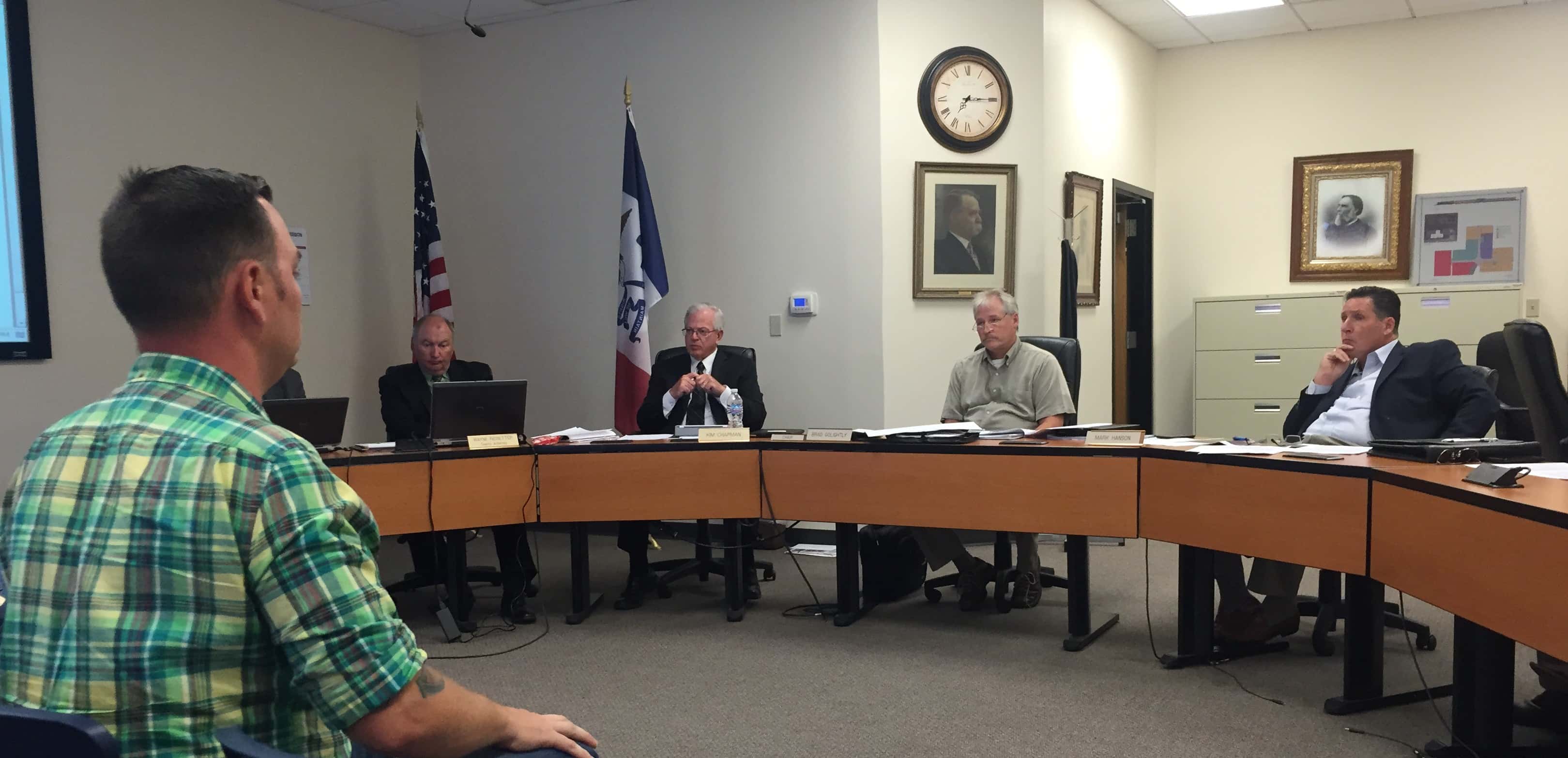
 The Dallas County Board of Supervisors held a second public hearing Thursday evening in regards to the master matrix scoring of a construction expansion permit application for Victor Allas LLC.
The Scheib family looks to expand their current Concentrated Animal Feeding Operation (CAFO) by building one additional building south of the current structures. According to a representative from the Pinnacle consulting firm, the operation’s proposal preparer, the proposed building is around 3,300 feet away from the closest neighbor, or three times the required minimum distance. It is also located four times the required minimum distance to a body of water at 2,100 feet. According to the master matrix scoring, the proposal received the maximum points possible for distance to water, wells, neighbors, schools, public areas. Additional points were also obtained for things like manure storage. A total of 400 points are required for approval, the proposal received 540 points.
Samuel Larson, a senior planner with the County’s Planning and Development Department, said his extensive mapping, examination and visits to the area echo the master matrix scoring of 540, more than the amount required for approval.
Stacy Hartmann with the Dallas County Farmers and Neighbors was the first member of the public to speak. She said Vistor Allas wants to add 7,200 heads of hogs, to the County’s 500,000 hogs. Hartmann said the master matrix did not address all of the questions and obtained a lot of points from “absurd” categories. In looking at the matrix, she stated that they found many points that should be deducted, along with a precedence in Poweshiek County that supports their argument for rejection to the expansion request. She told the Supervisors that continuing to approve CAFOs and saying it’s out of their control, and instead regulated by the legislature, is bad leadership.
Jan Danielson then asked Larson about his lack of experience in evaluating agricultural zoning. She said other counties have a committee that is trained in the master matrix and better served to critique them. She said the Pinnacle company has the tendency to copy and paste facts from one application to another. She encouraged the Board to reject the application. Larson said he did physically go to the site and measure the distances to other neighbors and water etc.
Dr. Sheryl Standy then stepped forward and said she recently went to the area of the operation. She said there is an extreme stench and she has concerns in regards to public health. Standy said people that hold the power, and intellect need to do the right thing for the next generation.
Mark Ripman then said he lives south of Dawson and he loves the area, with the exception of the local CAFO. Ripman says he has lived in the area for a year and is three miles from the proposed expansion. He questioned who benefits from CAFOs, besides the applicants. He asked the Board what the long term plan for CAFOs is in Dallas County and how many will be moved into Dallas County in the next 25 years.
David Hantz then spoke on behalf of the Raccoon River Watershed. He said the Raccoon River in the local area is polluted in excess of the federal limits. He said they can’t afford to further poison the water.
Jeff Hosner then said he lives a half mile west of the facility and the Scheib family also owns facilities in Guthrie County. He said the owners are doing nothing to alleviate the odor issues. He questioned why they can’t spend the money to put up a fence or fans to try and push the air up and out of the way. He said his goal is to improve the lives of those living in the area and a few small things could help make things better for everyone in the area.
Kent Schieb then said he has talked with several neighbors in the area and none, besides Hosner, have expressed objections to the expansion.
Pat Skeffington said she and her husband farm in Minburn and Dawson. She said her farm is a family farm, but the Scheibs are an industrial farm. She said the application is getting points for things that don’t make sense in terms of not being by a school, even though it’s in the country and for doing things that others are not doing. She said it’s the Supervisor’s role as elected representatives to do what’s best for everyone in the County and develop a plan for the future.
Sharon Dannoven then spoke on behalf of several organizations, she said there are many people impacted by these CAFOs. She said the expansion is not necessary and is damaging the environment. She said Iowa is ranked 49th out of 50 in terms of water pollution. She said the whole concept of CAFOs is inhumane and out of date. Dannoven said there’s a movement toward organic and clean farming and Iowa needs to work toward that. She said evidence shows that feeding an animal another animal, doesn’t make healthy sense. She encouraged the Supervisors to take a stand and support the environment.
Amy Stepanek, another neighbor close to the confinement who says she was never approached by the family to share her opinion, then stepped forward and said the stink in the area is an issue which also impacts overall air quality and water quality. She also said the stink extends for miles and impacts more than just those who live in close proximity. Stepanek said when she sleeps at night with the windows open they can not only smell but taste the aroma. She said if the Board doesn’t stop approving these “we’re in a lot of trouble.”
Mary Hokum then asked the Supervisors to look at the values used for approving or denying these applications. She said clean air, clean water, good relationships and a quality of life are more important than a small group of people’s ability to make more money.
Vern Teegus says he moved to Adel from Carroll County a year and a half ago. He said he dealt with a lot of CAFOs and he continues to fight on behalf of several organizations against them. Teegus said the Scheib family is simply farm laborers on behalf of Cargill Pork. He asked the Board to reject the application and move it on to the Department of Natural Resources for them to take the next step.
Rick Hartmann then spoke on behalf of the Iowa Farmers Union stating that one of their four platforms this year during the legislative session was to stop the expansion of CAFOs. He said the large operations are pushing out independent livestock owners in the state and they’re taking advantage of the tax benefits for farmers that are intended for small and independent operations. He said while there are legitimate points in the matrix scoring, it’s a C- kind of material that is copy and pasted. Hartmann said millions of gallons of liquid waste are involved and polluting. He said every CAFO building that is approved is 10 farmers taken out of work.
Dakota Skeffington Voss was next to speak. He said anytime something is approved it’s setting a precedent for the future. He said eventually there will be no family farms, only large corporate operations in Iowa.
Danielle Warth then explained Iowa’s landform regions and drainage issues. She said she doesn’t believe there’s any area in the state that is geographically capable of handling a CAFO. She said they should be held to the same standard as sewer management facilities.
Don Warth then talked about the state’s buried valley aquifers. He said the CAFO in question is located dangerously close to an aquifer that several communities get water from.
Emily Wynn and Linda Brewer then spoke on behalf of their five generation family farm. As the owners of a Dallas County CAFO they both stated that a lot of misinformation is being shared at the meeting. With an indoor operation, Brewer said they have an account for every single gallon of manure on their site, where that didn’t happen when they open air farmed. She said CAFOs are what needs to be had today and things need to evolve with the times.
Supervisor Kim Chapman then stated he felt the application was very vague and he was torn with the issue. He said the farmers are looking to support their families and continue the business for generations, though he too is concerned about the smell and water quality.
Chapman made a motion to reject the application based on vagueness. Supervisor Mark Hanson seconded the motion. He said he appreciated the history that was shared during the hearing, along with setting a precedent for future generations. Hanson said the Board does take their job very seriously and they want to do what’s best for the County.
County Attorney Wayne Reisetter then spoke about some legal actions that were brought up in the hearing. If they want to recommend disapproval of the application, he encouraged the Board to look at the scoring and determine why they feel it should not be approved.
Board Chair Brad Golightly then said he is in full support of the Scheib family and their operation. He stated that meetings like the one held Thursday allow people to come in and share their different opinions. Golightly said there is a process in place to evaluate best practices and the Scheibs did what was required of them for approval.
Ultimately, the Board voted 2-1 with Golightly voting against the motion to reject the application.