



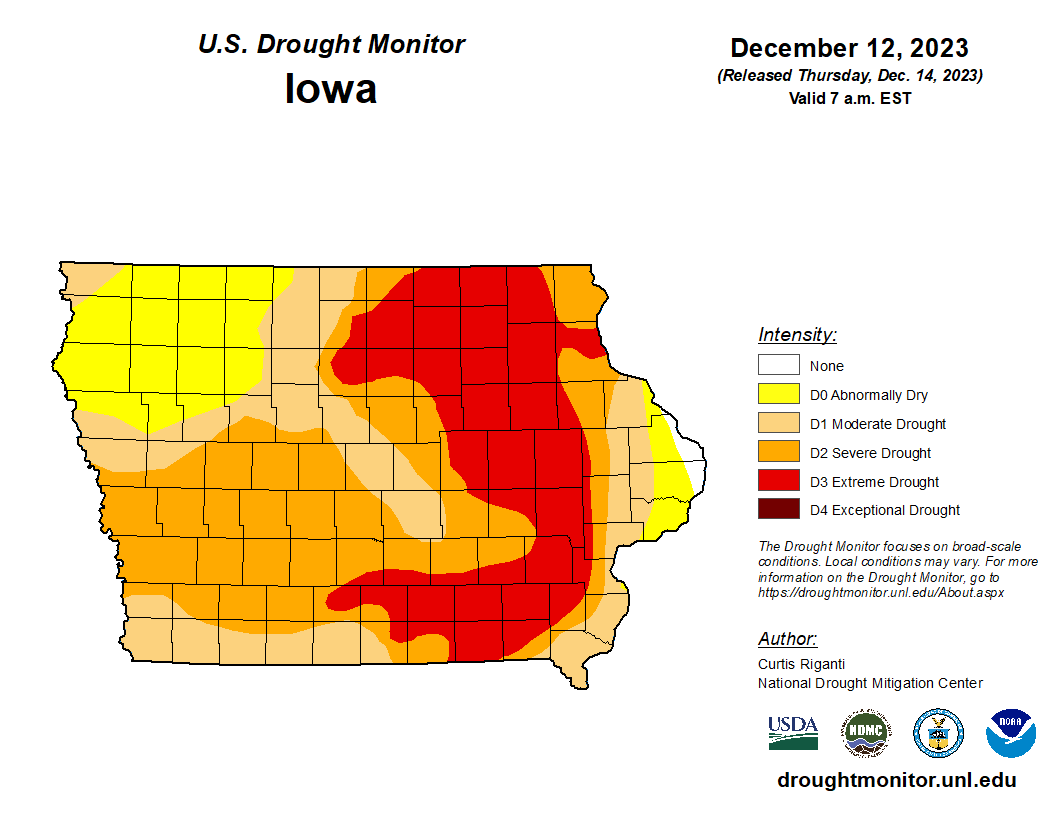
Image courtesy of US Drought Monitor
As 2023 winds down, across Iowa most of the state has been under some kind of drought.
State Climatologist Justin Glisan confirms that this year has been very dry as he goes over the figures through the end of October.
“We’re running about eight inches below average across the state and the driest part of the state would be east central and northeastern Iowa. They’re above ten inches below average. November, the fourth driest month climatologically for the state of Iowa.”
Glisan points out at the beginning of December, there have been 179 weeks of at least moderate drought conditions somewhere in Iowa since July 2020. He says one of the reasons is the three consecutive years of the La Nina phase of El Nino pattern, which are the dominate drivers of climate.
“We’ve shifted to El Nino winters and typically when we have El Nino spring, summer into fall and we have a high probability of a moderate to strong El Nino it’s looking like it possibility could be a historically strong El Nino, we see warmer temperatures as we get into the cold season. So late fall into winter and we’ve definitely seen warmer temperatures over the last few months. And then with the outlook suggesting warmer temperatures in December, which is a very El Nino-ish way of behavior when we look at those years in which we’ve seen this.”
According to the latest US Drought Monitor, Greene, Dallas and Guthrie counties are entirely in a severe drought. According to the National Weather Service, as of Thursday it has been 18 days since the Raccoon Valley Radio area has seen precipitation, when all three counties had over one inch of snowfall on November 26th.