



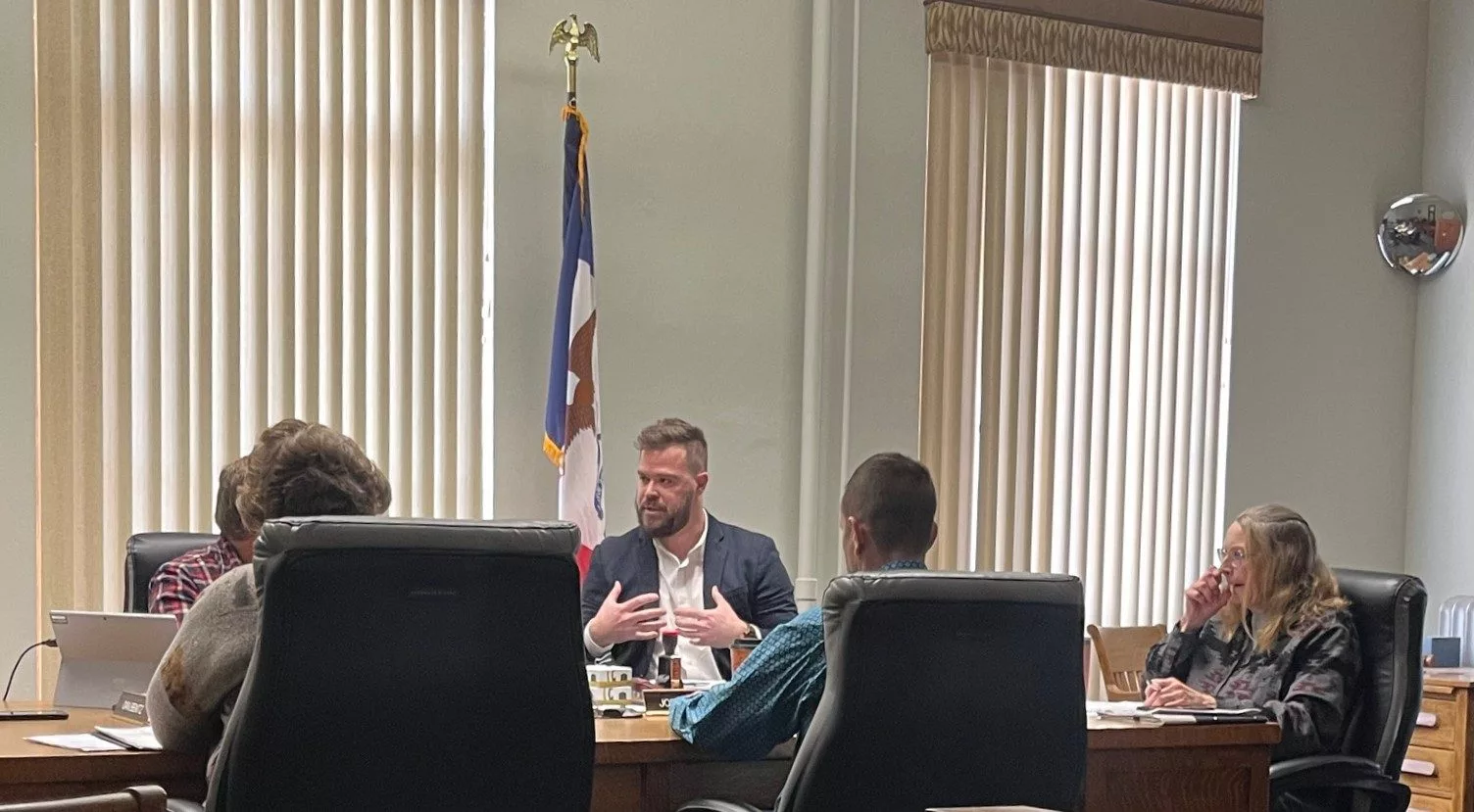
The Greene County Board of Supervisors met Monday in regular session.
During open forum, a resident shared a concern about the possible increase in water usage with the proposed underground carbon dioxide pipeline project. He spoke about a couple of his wells being damaged living close to the ethanol plant in Grand Junction and was worried that with the additional water usage with the pipeline project, he had asked the Board to monitor that usage. County Attorney Thomas Laehn said that the only permit process for water usage would be through the Iowa Department of Natural Resources but that the Board could structure a monitoring system.
The Board then heard a presentation from the Executive Director of the Iowa Bicycle Coalition Luke Hoffman about a recent economic impact study with Jefferson as a specific case study. He went over some of the local figures that were included in the statewide report and offered the coalition’s services to be a resource and contribute letters of support for grant opportunities. Hoffman asked about several funding possibilities within the county that could be used to repave the 14 miles section on the Raccoon River Valley Trail. The Board said that most of the tax increment financing (TIF) funds were spoken for mainly with road projects and the county was bonded heavily with the new county jail and emergency communication tower projects.
Jamie Daubendiek, who is an advocate for the trail and as head of Jefferson Telecom contributed funds through their foundation in support of the case study within the overall economic impact report, said that people from Des Moines have told him that they will not take the trail up to Jefferson due to the condition of the pathway. Greene County Conservation Director Tanner Scheuermann said that when the trail was originally built, the loop was not established and if the path can be repaved then they could capture those cyclists to come to Greene County off of the spur to Jefferson. Jefferson Mayor Craig Berry said he has been in contact with the federal senators and congressional representatives asking about federal funding to be used as well. No action was taken by the Board following the presentation.
Next, the Board approved a 28E agreement with the city of Jefferson to provide recycling services for the unincorporated parts of the county. Laehn mentioned that the county would continue to pay for recycling services and provide drop box locations that the city would pickup recycling from every two weeks. The agreement could be terminated by the Board after they received the rate from the city on January 1st and have until January 15th to terminate the agreement.
The Board also approved consent to adjust a legal description of land that is bequeathed to the county. Laehn said the Teagarden Estate left a parcel to the county to be used as a wildlife refuge. However, the parcel was landlocked and an agreement with an adjacent recipient who farms the parcel would swap their parcel they received so that the county had a road access to the land.
Finally, the Board held two discussions with Heidi Kuhl from Northland Securities. The first one was about a general obligation general fund loan for the HVAC project for the Greene County Courthouse. Kuhl said the two hearings needed to take place in order for the Board to have the authority to borrow up to $2 million from the general fund, along with using the remaining funds from the American Rescue Plan Act of the HVAC project. Once the two hearings have happened, then the process can begin to setup receiving that loan. Auditor Billie Jo Hoskins noted that prior to the second hearing happening, residents have an opportunity to petition to have the measure be on a ballot for the November election. Following the discussion, the Board agreed to move forward with the timeline to establish the two public hearings.
The other discussion was about the TIF funds for the road projects. Kuhl said the bids were favorable for the $11.5 million road projects related to the TIF funds from the windmills. Kuhl then laid out a timeline to when those debt service bond proceeds could be collected for construction to begin.